


How Biomass Pellets and Briquettes Are Quietly Reshaping India's Energy System?

India's energy transition gets a lot of attention for its solar panels and wind farms — and rightly so. But there's another, quieter revolution happening in warehouses, boiler rooms, and farm fields across the country, even in the kitchens next door. Compressed biomass — in the form of pellets and briquettes — is steadily carving out a role in India's energy future, and the implications go far beyond clean fuel.
What Are They, and Why Do They Matter?
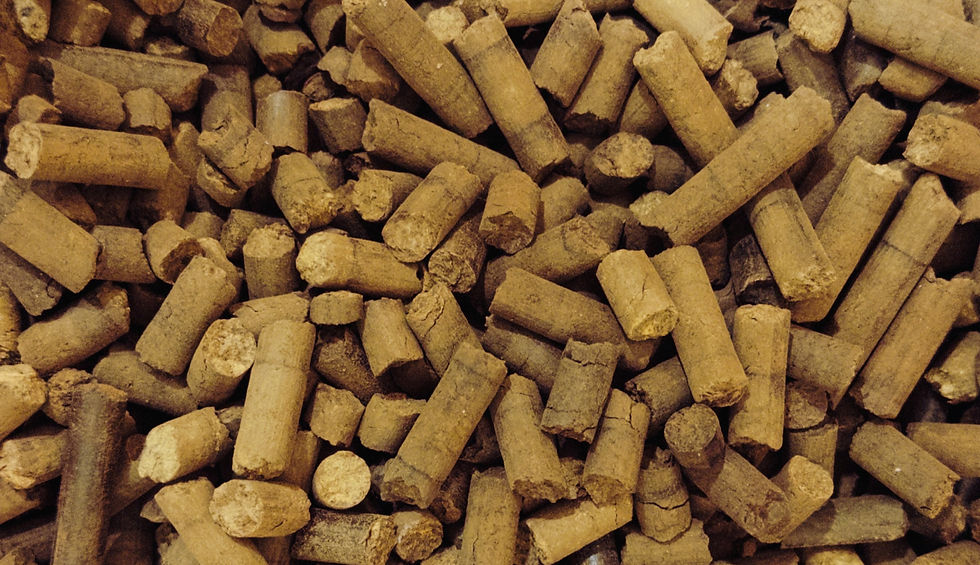
Biomass pellets and briquettes are essentially agricultural and forest waste — paddy straw, rice husk, mustard husk, sugarcane bagasse, sawdust, bamboo — compressed under heat and pressure into dense, uniform fuel blocks. They burn cleaner than raw biomass, are easier to transport and store than loose agricultural waste, and crucially, they can directly substitute for coal in industrial boilers and thermal power plants.
Briquettes are typically larger and less dense, making them suited for industrial applications, while pellets — recognised for their uniformity and high density — are preferred for residential heating and small-scale power generation. Both, however, address the same fundamental challenge: India generates enormous quantities of agricultural residue every year, much of which is burned in the open, choking cities from Delhi to Amritsar every winter.
The Stubble Burning Problem — Turned Into an Opportunity
Every post-harvest season, North India disappears under a haze of crop residue smoke. Farmers burn stubble because it's the fastest way to clear fields before the next crop. The air quality consequences are severe, and the carbon emissions are significant. Biomass pellets offer a direct solution: instead of burning stubble in fields, it becomes feedstock for energy production.
Companies like Punjab Renewable Energy Systems Private Limited (PRESPL) leverage the abundant agricultural residues in Punjab — rice husk and wheat straw — to produce biomass briquettes and pellets, providing cost-effective feedstock for biofuel production while directly addressing crop stubble burning and the air pollution it causes.
This is the beauty of the biomass pellet model: it turns a pollution problem into an energy product, a waste stream into a revenue stream, and idle farm labour into supply chain participants.
The Government Mandate That Changed Everything
The single biggest demand driver for biomass pellets in India came from an unlikely place: coal power plants. The Ministry of Power initiated the National Mission on use of biomass in coal-based thermal power stations — known as SAMARTH — mandating all coal-based power plants to blend a minimum of 5% biomass pellets along with coal.
From FY 2025–26, the Ministry of Power has raised this to a 7% biomass co-firing mandate across all coal-based thermal power plants. Maharashtra went even further — notifying a state-specific bamboo biomass blending mandate in December 2025, backed by ₹13,331 crore in government incentives.
This is a game-changer. It means that every coal plant in India — which together generate the majority of the country's electricity — now has a legal obligation to buy biomass pellets. That's an assured, large-scale demand signal that didn't exist five years ago.
The benchmarking of the off-take price proved a major turning point in streamlining the tendering process, giving pellet manufacturers visibility into what they'd be paid and making the business case far more bankable.
The Supply Gap: A Massive Market Opportunity
Here's the uncomfortable truth behind the mandate: India doesn't yet produce enough pellets to meet it. India's daily demand for biomass briquettes and pellets is approximately 95,000 tonnes, but current production capacity is only around 8,000 to 10,000 tonnes per day. That gap — roughly ten times the current production — represents one of the largest unmet demand opportunities in India's renewable energy sector.
Thermal power plants and state programmes are still struggling to meet co-firing targets because domestic pellet supply is uneven — creating a clear opening for manufacturers who can deliver consistent, quality-certified supply at scale.
What It Looks Like on the Ground
The density of pellet fuel is substantially higher than raw biomass — around 640 kg/m³ versus 160–400 kg/m³ for raw material. More fuel can be transported in a given truck space, more energy stored on-site, and the uniform shape and size allows for simpler, lower-cost feed systems.
This technical advantage matters enormously for industrial users. A cement plant, a textile mill, or a paper factory switching from coal to biomass briquettes isn't just making an environmental choice — it's choosing a fuel that produces far less ash (6–10% versus 15–30% for coal), is generally less expensive, and is easier to handle and store.
The Indian biomass pellets market was valued at USD 552 million in 2023 and is projected to reach USD 1.2 billion by 2035 — a trajectory driven by co-firing mandates, industrial heat demand, and the growing realisation that agricultural waste is a resource, not a problem.
The Challenges Are Real
It would be misleading to paint this as a smooth, frictionless transition. Feedstock security is the primary operational risk for any biomass plant. Availability is seasonal, and without pre-agreed supply arrangements, plants face production gaps. Raw material aggregation in high-demand states like Punjab, Haryana, and Uttar Pradesh is becoming increasingly competitive as more producers enter the market.
The Bigger Picture
Biomass pellets and briquettes sit at a unique intersection in India's energy story. They address air pollution (stubble burning), they support farmer incomes (crop residue monetisation), they provide a transition fuel for industries and power plants still dependent on coal, and they do all of this using feedstock that is already being generated across the country — often discarded or destroyed.
Densified biomass, including pellets and briquettes, is emerging as a viable coal substitute — not a permanent endpoint, but a critical bridge technology for a country that needs to decarbonise its industrial base without abrupt disruption to the millions of livelihoods tied to coal.
India's solar panels get the headlines. But in the quiet hum of a pellet press turning paddy straw into fuel, something equally important is happening.
Sources: MNRE BioURJA Portal · Ministry of Power SAMARTH Mission · IREDA Biomass Financing Scheme · PelletRates.in · Indian Federation of Green Energy · Daily Pioneer · BioBiz India · JEL Sciences


Comments